Remember the brown folder at the hospital records office, the one that sometimes got lost? It is slowly becoming a digital record.
Federal teaching hospitals in Nigeria now use electronic medical records in about three out of four facilities on average. More than 120 health tech startups have raised over $271 million, and the government is building a national system so hospitals, labs and health apps can share information safely.
This can mean fewer lost folders, fewer repeated tests and faster care. But it also raises a big question: who can see your health information, and what can you do about it?
What's changing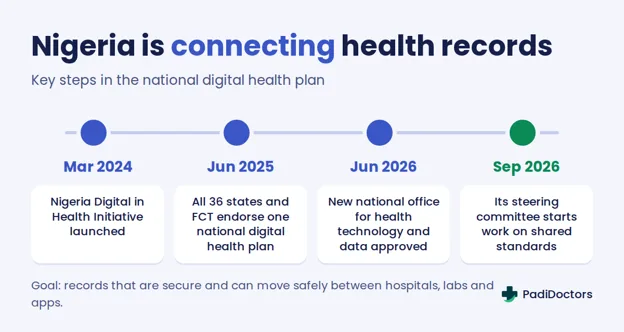
- In June 2025, all 36 states and the FCT endorsed one National Digital Health Architecture, with common standards for electronic health records.
- In June 2026, the President approved a new National Health Technology and Data Analytics Office to coordinate digital health across the country. Its steering committee met for the first time in September.
- Officials say three principles must guide every digital health service: security, systems that can talk to each other, and protecting Nigerians' data.
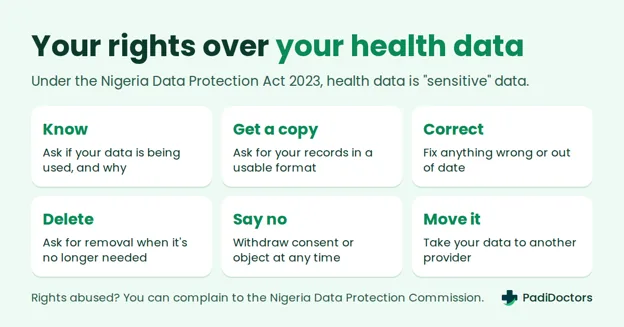
Under the Nigeria Data Protection Act 2023, information about your health counts as "sensitive personal data", so it gets extra protection. You have the right to:
- Know if a hospital, lab or app is using your data, and why
- Get a copy of your data in a format you can use
- Correct anything that is wrong or out of date
- Ask for it to be deleted when it is no longer needed
- Withdraw your consent or object, at any time
- Move your data to another provider
If your data is leaked, the organisation must report it to the Nigeria Data Protection Commission (NDPC) within 72 hours, and tell you quickly if you are at high risk. If you feel your rights have been abused, you can complain to the NDPC.
5 questions to ask any clinic or health app- Do you ask my permission before you collect or share my health information?
- Who exactly can see my records?
- Can I stop a doctor from seeing them later?
- Can I get a copy of my records, or move them elsewhere?
- Are your doctors licensed, and what happens if there is a data leak?
If a clinic or app can't answer these clearly, think twice before handing over your information.
How PadiDoctors protects your records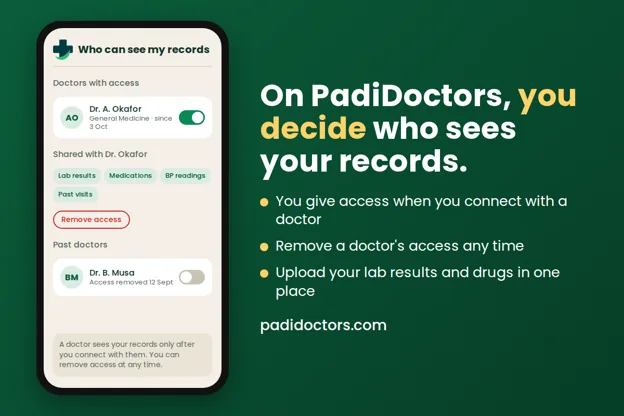
- You decide who sees your records. A doctor can see your health records only after you connect with them.
- Remove access any time. You can stop any doctor from seeing your records, and the access stays off until you choose to share again.
- Your records in one place. Upload your lab results, medications and readings like BP or sugar, so the doctor you choose has the full picture.
- We ask before we collect. We ask for your consent, and you can ask us for a copy of your data or to correct it.
- Licensed doctors only. Every doctor on PadiDoctors is licensed.
Your health story belongs to you. See how it works at padidoctors.com.
References- Nigeria needs ₦500 billion to scale digital health infrastructure over five years – Premium Times (June 2026)
- Nigerian govt unveils blueprint for secure, interoperable digital health system – Premium Times (July 2026)
- Experts urge stronger systems as Nigeria's digital health investment hits $271m – The Guardian Nigeria (July 2026)
- Another office or a stronger system? The institutional test for Nigeria's digital health agenda – Nigeria Health Watch (July 2026)
- FG inaugurates NHTDAO steering committee to drive patient-centred digital health – West African Pilot (Sept 2026)
- An overview of Nigeria's Data Protection Act, 2023 – Securiti
- Nigeria Data Protection Act, 2023 (full text) – ngCERT