You get to the hospital early, and the gate is quiet. "We are on strike."
For many Nigerians, this is becoming familiar. In just the past few weeks:
- Health workers in Katsina began a seven-day warning strike on 14 October. It is their second warning strike in two months, while the state is still fighting diphtheria.
- Staff at the Federal Medical Centre, Abeokuta began a three-day strike after a colleague was allegedly stabbed by a patient's relative.
- Resident doctors at UCH Ibadan have just suspended a three-day warning strike, weeks after allied health workers there paused theirs.
- In Delta, a strike by allied health workers over unpaid allowances put public hospitals under pressure in September.
Health workers strike for real reasons: unpaid allowances, low pay and unsafe working conditions. But while it is being sorted out, patients still need care. Here is how to protect yourself and your family.
Emergencies first
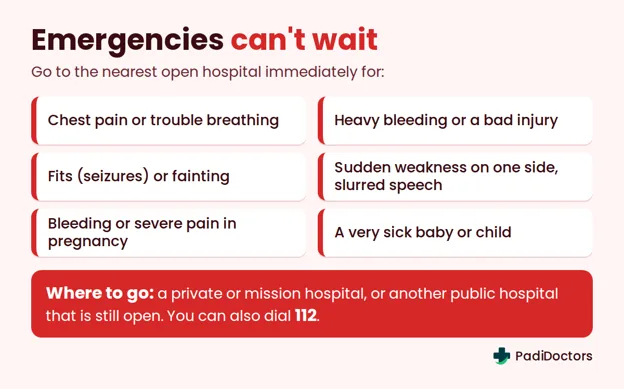
A strike does not mean you should wait at home with an emergency. Go to the nearest open hospital immediately for:
- Chest pain or trouble breathing
- Heavy bleeding or a bad injury
- Fits (seizures) or fainting
- Sudden weakness on one side of the body or slurred speech
- Bleeding or severe pain in pregnancy
- A very sick baby or child
Where to go: a private or mission hospital, or a public hospital that is still open. A strike by state health workers may not affect federal hospitals, and the other way round, so check. Some hospitals on strike still run a small emergency service, so ask at the gate. You can also dial 112 for emergency help
Keep your care going
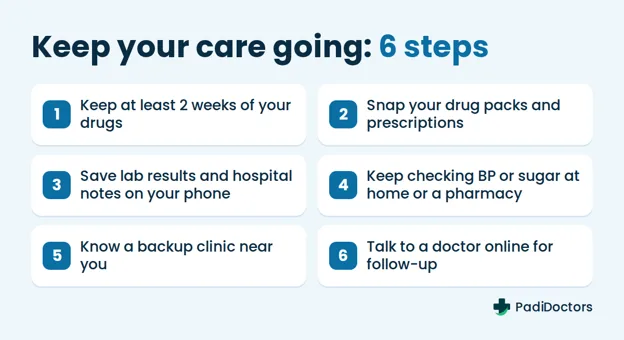
If you live with high blood pressure, diabetes, asthma, sickle cell or another long-term condition, a strike can quietly break your treatment. These steps help:
- Don't let your drugs run low. Refill while you still have at least two weeks left.
- Snap your drug packs and prescriptions so any doctor or pharmacist can see what you take.
- Save your lab results and hospital notes on your phone.
- Keep checking your BP or sugar at home or at a pharmacy, and write the numbers down.
- Know a backup clinic near you before you need it.
- Talk to a doctor online for follow-up, so you're not on your own until the strike ends.
Never stop or change your drugs on your own because you can't see your doctor.
How PadiDoctors can help
- Talk to a licensed doctor, free for a limited time. Go over your treatment and your BP or sugar readings, and agree what to do next, from home.
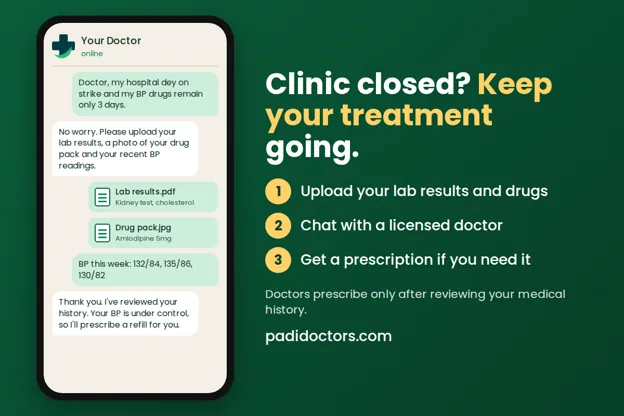
- Prescriptions and refills. Upload your lab results, a photo of your drug packs and your recent BP or sugar readings. After reviewing your medical history, the doctor can prescribe or refill your medication if you need it.
- Lab tests. Book tests at our partner laboratories in selected states.
- Free symptom checker. Find out if what you feel needs a hospital now or can wait. English or Pidgin.
- Your records stay with you. The doctor you connect with can see your health records until you choose to stop sharing.
PadiDoctors is not an emergency service. For any of the danger signs above, go to the nearest open hospital first.
Strike or no strike, your health no fit wait. Visit padidoctors.com.
References
- Katsina health professionals declare 7-day warning strike – Premium Times (15 Oct 2026)
- Diphtheria outbreak: more patients at risk as Katsina health workers declare warning strike – allAfrica (Sept 2026)
- Ogun hospital workers begin 3-day strike after patient's relative stabs medical scientist – allAfrica (Oct 2026)
- UCH resident doctors call off three-day warning strike – Africa Health Report (15 Oct 2026)
- Allied health workers suspend strike at UCH for two weeks – Peoples Gazette (Sept 2026)
- Health crisis in Delta as allied health workers strike escalates – Vanguard (Sept 2026)